Instruction Blindness in Vision–Language–Action Policies
Diagnosis and a low-rank data cure. We release Galahad, the policy that validates it.
change one word → the arm changes its mind.
Instruction blindness
A vision–language–action policy can pass a manipulation benchmark without reading its
instruction: replace the words with the string xxx and it emits the same actions. It succeeds by
moving to the object that usually occupies the target position, not by resolving the name. We call this
failure mode instruction blindness and show it is a concrete instance of causal
confusion in imitation learning. On the one axis that separates a position shortcut from language
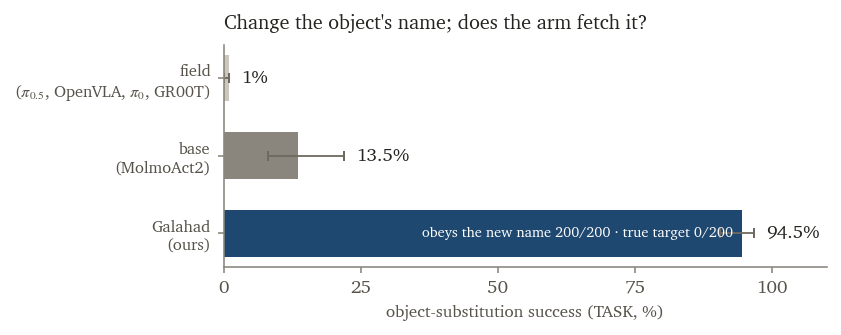
grounding — object identity, rename the target and keep the scene — the published field selects
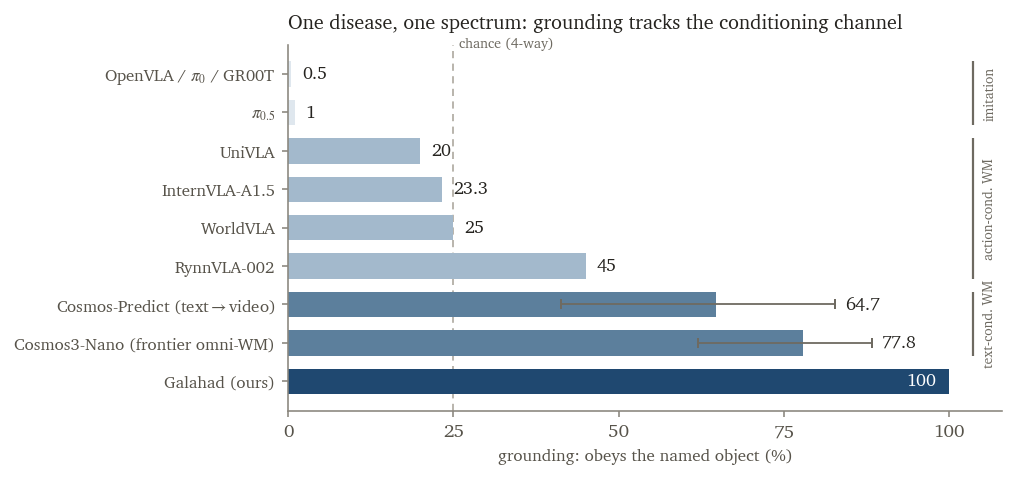
the correct object 0–1% of the time.
A severed route, not missing knowledge
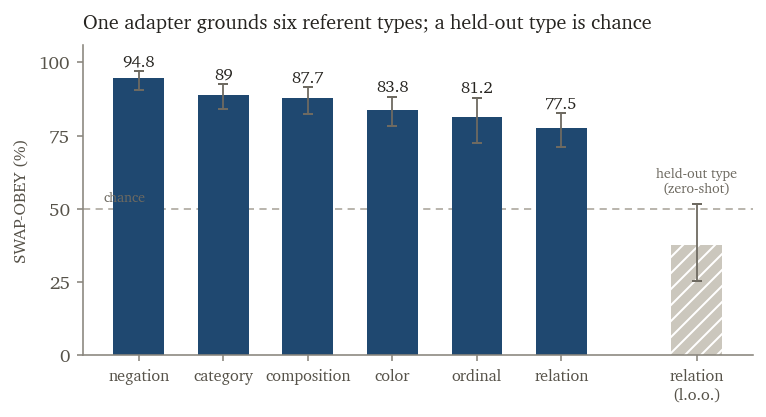
The pretrained backbone already resolves the named object in its language stream — activation patching localizes the binding to a single head, and injecting the word direction at an early layer flips the selected object 100% of the time — but the action head routes position and never reads that binding. Because the knowledge is present, the repair is a data recipe, not an architecture: make the instruction the only predictor of the target, and protect the pretrained grounding with a low-rank update. Full fine-tuning on the identical data destroys grounding (12.5%); the low-rank cure installs it (94.5%). The released weight grounds seven referent-type axes in one set of weights — object identity, spatial, goal, color, category, negation, composition (obey 75–99%, occlusion ≤2% on every axis).
Results
Measure the shortcut in any policy
The measurement is a one-command counterfactual. It runs the same test on your policy: not a drop under perturbation, but a positive control — rename the target, and does the arm go to the newly named object?
from galahad.battery import run

report = run(policy, suite="libero_object")
report.swap_obey    # goes to the newly named object?  (grounding)
report.occ          # collapses with blank cameras?     (uses vision)
report.nonsense # collapses on a meaningless name? (needs a real name)Cite
@misc{liu2026instructionblindness,
  title  = {Instruction Blindness in Vision-Language-Action Policies:
            Diagnosis and a Low-Rank Data Cure},
  author = {Liu, Yuchen and Han, Muchen},
  year   = {2026}
}